This Week in AI Media: Disney Unlocks its Vault for Sora, Kling O1 Redefines Multimodal Video, and Google Eyes Faster Image Generation
A billion-dollar deal changes the game for fan creativity, while Kling's new "O1" model promises a unified video engine for creators.
Ryan Lee Birnie-Browne
12/12/20253 min read
This week has been a watershed moment for generative AI in media, marked by a colossal partnership between legacy entertainment and Silicon Valley, the launch of powerful new unified models from Asia, and a push towards faster, more democratized image creation. From the Magic Kingdom opening its gates to AI to platforms that turn viewers into players, the landscape of digital content creation is shifting rapidly. Here are the biggest stories in AI video and image generation from the past week.
The Blockbuster Deal: Disney Invests $1 Billion to Bring Characters to OpenAI's Sora
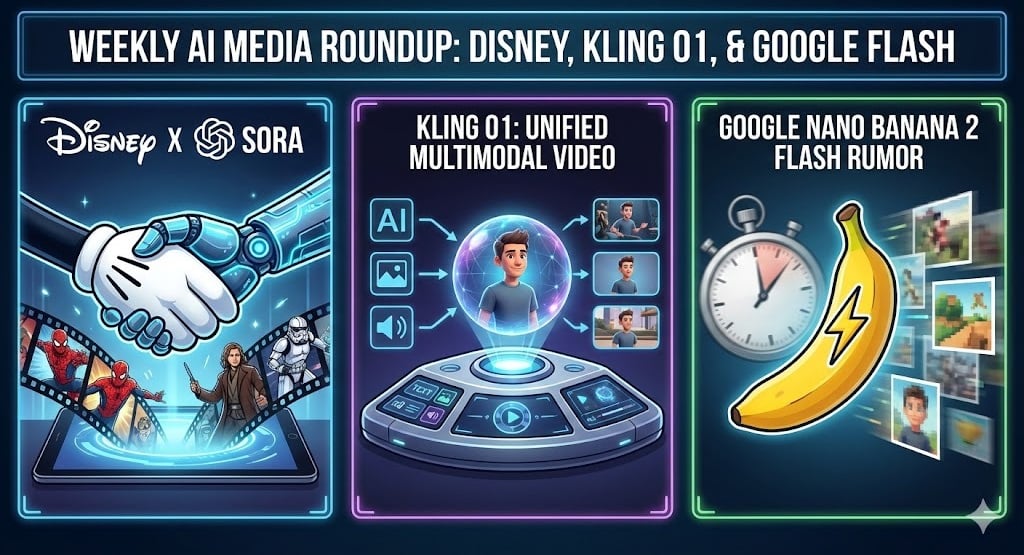
In the biggest news of the week, The Walt Disney Company has announced a massive $1 billion investment in OpenAI, forming a strategic partnership that will reshape fan engagement. The deal allows users of OpenAI’s text-to-video tool, Sora, to generate short-form videos using Disney’s vast library of iconic characters from Marvel, Star Wars, Pixar, and classic animation.
This move is framed as a way to empower fan creativity, allowing individuals to create their own "fan-inspired Sora short form videos." Disney has indicated that select fan-made content could even be showcased on the Disney+ streaming service, potentially creating a new content funnel to compete with platforms like TikTok and YouTube Shorts.
Crucially, amid ongoing anxiety in Hollywood about AI's impact on creative professions, Disney emphasized that the licensing agreement does not cover talent likenesses or voices. The focus is strictly on animated characters and intellectual property, a clear attempt to navigate the sensitive landscape of creative rights.
Kling O1 Launches: A New "Unified" Standard for Video
While OpenAI grabbed headlines with partnerships, Chinese AI giant Kuaishou made a massive technical leap with the release of Kling O1, their first "Unified Multimodal Video Model."
Launched as part of their "Omni Launch Week," Kling O1 represents a shift away from specialized tools for different tasks. Instead, it positions itself as a single, all-encompassing engine capable of handling text-to-video, image-to-video, and complex editing tasks with a higher degree of reasoning.
"Input Anything, Generate Any Vision": The model is built to understand complex, multimodal instructions better than its predecessors, allowing for more precise adherence to user prompts.
The Element Library: One of O1's standout features is its new "Element Library," which addresses the biggest pain point in AI video: consistency. Users can now upload multi-angle reference images of characters or items, and the O1 model effectively "remembers" them, allowing for consistent character generation across different scenes and clips.
Kling Video 2.6 & Native Audio: Alongside O1, Kling also released the Video 2.6 model this week, which introduces "native audio." This means the model generates sound effects and backing tracks simultaneously with the video, rather than as a post-processing step, ensuring perfect sync between visual motion and audio cues.
AI Video Evolves: Interactive "Playable" Content and All-in-One Studios
Beyond the big model releases, the technology itself is evolving into new formats.
Playable Video Games from Prompts: A new platform called Beam launched this week, powered by Google's Veo 3.1 model. It allows creators to build playable mini-games and interactive stories directly in a browser using AI-generated video, images, and music—no coding required.
Full-Stack AI Video Agents: Another platform, DeeVid AI, announced a major upgrade, shifting its focus to "AI Video Agent" workflows. This integrates AI music generation and text-to-speech capabilities alongside video creation, aiming to provide a single, end-to-end studio for producing finished content.
AI Image Generation: Rumors of a Faster, "Flash" Future
While video grabbed the headlines, the AI image generation space is also gearing up for a significant shift focused on speed and accessibility.
Reports emerged this week suggesting Google is preparing to launch a new version of its image generation model, tentatively dubbed "Nano Banana 2 Flash." This model is rumored to prioritize speed and low-latency generation over absolute pixel-perfect precision, making it a lighter and more affordable alternative to its high-end "Pro" counterpart.
Conclusion
This week's news paints a clear picture of the future of digital media. The walls between professional studios and fan creators are becoming more porous, sophisticated models like Kling O1 are solving critical consistency issues, and powerful creative tools are becoming faster and more accessible than ever. As giants like Disney embrace the technology and new platforms rewrite the rules of engagement, we are entering a new era where the only limit to content creation is imagination.